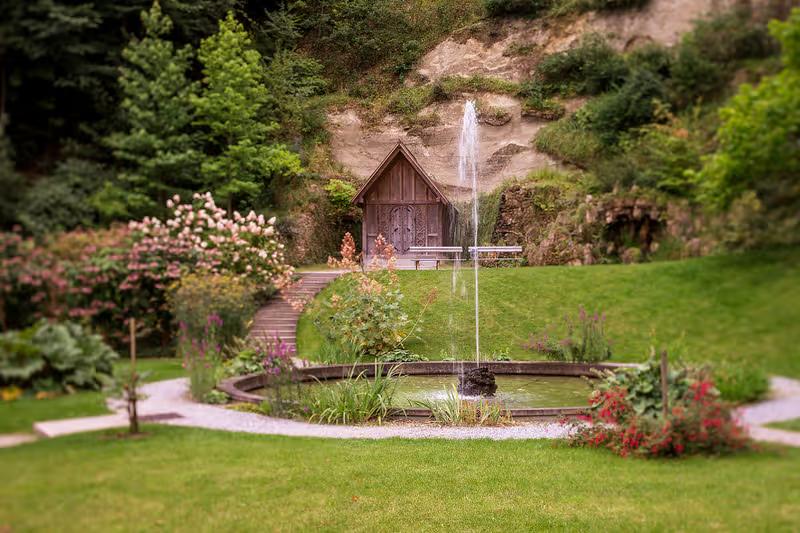
Arenenberg has always been surrounded by a variety of gardens. Even today, this diverse garden landscape, though compact, offers a journey through the evolution of European garden design over the last 600 years.
As early as the Middle Ages, patricians from Thurgau and Constance established an impressive pleasure garden – initially in the strict Renaissance style with clear geometric forms. Today, the estate presents itself as a 19th-century landscape park, characterized by a striking interplay of light and shadow, water, and forest.
In 1816, Hortense de Beauharnais, stepdaughter of Napoleon I, acquired Arenenberg Castle and immediately fell in love with its romantic location overlooking Lake Constance. She not only redesigned the salons but also created a landscape park on a plateau below the castle, which is considered the first "imperial" park. Hortense integrated elements from earlier eras such as water features, grottoes, and a hermitage, while simultaneously leveling the terraces.
Names like the "Italian Terrace" still evoke the Renaissance today. She created a sophisticated network of paths and a modern water supply system, which made features like the "Grand Fountain" possible. During this period, the first orangery was also built, along with a kitchen garden (potager) between the orangery and what would later become the guesthouse. Orchards and fields were preserved, and viticulture was particularly dear to Hortense, as grape harvesting was among her favorite activities.
Her son, Louis Napoléon, later Emperor Napoleon III, continued this gardening tradition. He expanded the arboretum with exotic plants, and laid out flowerbeds and borders in elaborate, geometric patterns, some of which are still visible today. He also created the "Pleasure Ground" with its central fountain. Mother and son ensured that the gardens were maintained according to the ideas of Prince Pückler. This also included the utility gardens, a tradition that continues today in the Arenenberg school gardens.